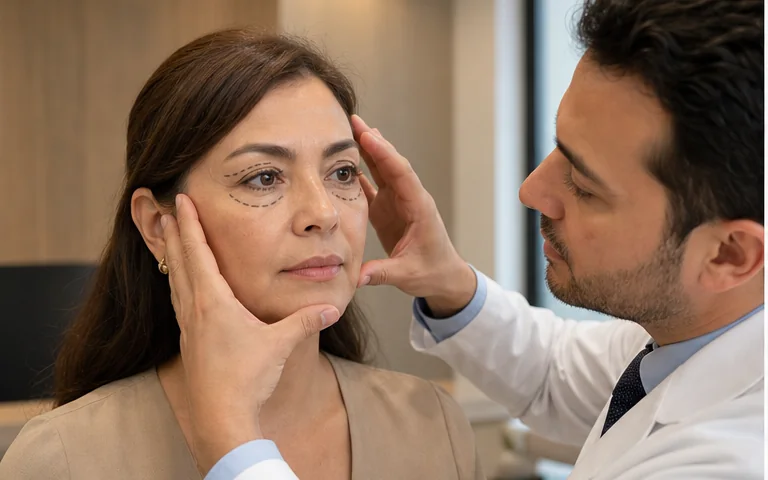
Upper blepharoplasty: excess skin above the eye
The upper eyelid changes because of skin quality, tissue descent, brow position and natural anatomy. Some patients notice heavy folds, difficulty applying makeup or a tired appearance. A low brow may contribute and must be distinguished from true eyelid skin excess.
Upper surgery may remove a carefully measured amount of skin and, when indicated, address fat. Excessive removal can affect closure, create tension or change expression, making conservative design essential.
If skin interferes with the visual field, functional evaluation may be appropriate. This should be confirmed rather than assumed.
Lower blepharoplasty: bags and the eyelid-cheek transition
Under-eye concerns may come from protruding fat, excess skin, laxity or a deep groove. These are not interchangeable. A bag is not treated the same way as pigmentation or volume loss.
Surgery may reposition or reduce fat, address skin and improve support. The approach depends on whether skin, fat and eyelid stability need treatment.
Lower blepharoplasty does not erase every dark circle. Pigment, vessels and bone structure may remain.
Key differences between upper and lower surgery
- Area: above the eye versus below the eye and its transition to the cheek.
- Common concern: excess skin above; bags, grooves or laxity below.
- Additional evaluation: brow and visual field above; eyelid support and cheek transition below.
- Specific risks: closure problems above and eyelid-position changes below, among other risks discussed in consultation.
When are they combined?
Upper and lower surgery may be performed together when both areas need treatment and the patient’s health supports a combined plan. Their relationship to brow position, a facelift or nonsurgical options may also be assessed.
Combination does not mean removing more tissue. The goal is often to distribute correction while preserving a natural relationship between the eyes, cheeks and brows.
What is reviewed before choosing
A blepharoplasty consultation in Colombia should review eye health, dry-eye symptoms, contact lenses, previous surgery, medications, vision, eyelid closure, brow position and goals. It should also explain scars, swelling, follow-up and warning signs.
Schedule an eyelid assessment
The correct indication requires physical examination and eye-health review. Photos alone cannot confirm technique or candidacy.
Schedule a consultationFrequently asked questions
Can upper and lower blepharoplasty be performed together?
Yes, when both areas need treatment and the combined plan is appropriate for the patient’s health and anatomy.
Does lower blepharoplasty remove every type of dark circle?
No. Pigment, visible vessels, grooves, bags and bone structure have different causes and may need different treatment.
Does upper blepharoplasty lift the brows?
Not necessarily. A low brow requires separate assessment so eyelid skin is not removed excessively.
Which procedure leaves a more visible scar?
Incisions depend on technique and anatomy. Final appearance is influenced by healing, aftercare and sun protection.
How is the correct technique selected?
Through assessment of the eyelids, brows, bags, skin, dry eye, vision, medical history and goals.